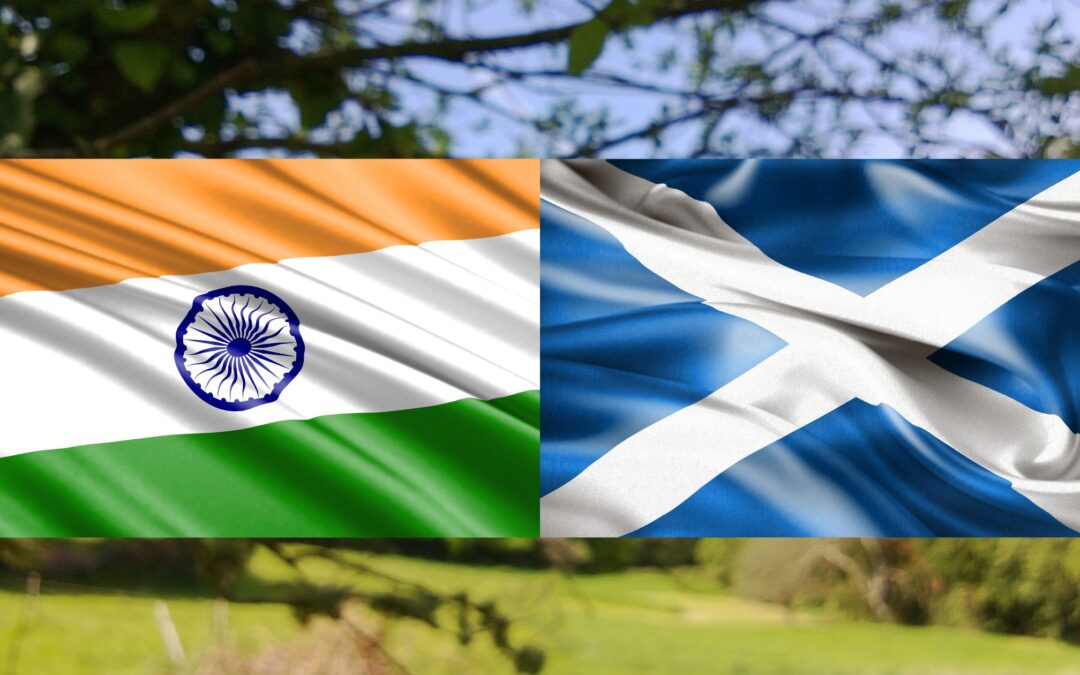
Being of Indian heritage and having lived in Scotland for the majority of my life, I have experienced first-hand, the long and intertwined history of these two wonderful nations.
Indo-Scottish ties date back nearly four centuries to 1618 when there was a speculative effort to create a Scottish East India Company but it wasn’t until the 1660s, that the Scots began increasing their activity along the trade routes to India, Africa, and China.
By the 18th century, Scottish sailors came to be regarded as reliable seamen and actively engaged in coastal trading in India, trying to find ways to join the Dutch East India Company. It was during this time that Scots began migrating to India in large numbers as East India Company military, medical, and maritime staff and as free merchants.
Today, Scotland is home to approximately 33k citizens of Indian heritage and with Glasgow named “Curry Capital of Britain” more times than any other city in the UK, it is clear that Scots have not only welcomed Indians into their communities but also share a love of Indian cuisine.
India has always been a priority partner for international engagement as Scotland continues on its path of sustainable economic growth, as we at PG Paper know well. Scotland’s strengths in education, energy, and India’s position as the world’s largest democracy, with an unrivalled youth demographic, may allow both countries to achieve their economic goals. In fact, one quarter of the global labour force will be Indian by 2030. That’s not surprising if you pay attention to India’s young ambitious workforce and the country’s spirit of entrepreneurship and creativity.
Scotland has created an International Framework, with four strategic objectives aligning with India’s priorities:
Objective 1 – Global Outlook: Trade and Investment
This strategic objective of a global outlook underscores Scotland’s ambitions to support more companies to do business in India, increase Scottish exports to India, seek more high-value investments from India into Scotland, and encourage greater talent and knowledge partnership between the two countries.
In a recent interview with the Business Standard, Robert Taylor, a senior spokesman for the Scottish government in Edinburgh, commented: “India is an increasingly important market for Scotland and is identified as one of the top 20 countries for export growth.”
One might be surprised to learn that Indians buy the most whisky in the world. Scotch whisky is a significant attraction for Indian consumers despite the 150% duty on imports by India. In 2021, India is projected to earn over £16 million in revenue from the whisky sold in the country.
India is in fact the eleventh largest inward investor in Scotland, and this could change if the incentives provided by the UK government and India’s economic outlook enhance outward activity on the part of Indian companies. Some of the top Indian companies like TCS, Genpact, Wipro, Hinduja Global Services Limited, and Piramal already have a strong presence in Scotland, and they continue to grow their businesses successfully. We need to see more Indian companies set up their offices in Scotland.
Objective 2 – Relationships and Partnerships: Education and Skills
The partnership between India and Scotland extends to education and skill-building, with demand for education high in India. Scotland is internationally renowned for its leading higher education system and with the promotion and uptake of education a key tenet of Indian culture, this is an increasingly important area for India and Scotland to focus on. Interestingly, India is Scotland’s fifth-biggest international market for further and higher education students, and as of 2016, sixteen of Scotland’s higher education institutes had academic and research links with Indian universities.
This academic partnership is further highlighted by The Edinburgh India Institute at the University of Edinburgh, which aims to encourage a greater awareness of India in Scotland and to build Scotland’s cultural, business and academic ties with India.
Objective 3 – Reputation and Attractiveness: Energy
India’s large population consumes a lot of energy; the Indian government plans to not only generate an additional 175 GW of renewable energy by 2022 but also build a strategy to transition to more sustainable sources of energy.
Since Scotland is well-positioned to partner with India on energy, we need to see greater collaboration between the Scottish and Indian governments on new and renewable energy technology, and on supporting entrepreneurs from India and Scotland to establish energy businesses. One example of this type of partnership is between Global energy consultants Enzen and Glasgow clean energy tech company Smarter Grid Solutions, who were awarded India’s first Active Network Management (ANM) contract.
I’m keen to see how Scotland boosts its profile as a renewable energy powerhouse to economically benefit both countries.
Objective 4 – Culture, Heritage and Tourism
I can’t write about India and not mention Bollywood. Since 1998, over 20 Bollywood films have been shot in Scotland, including the latest blockbuster Bell Bottom. My wife and I were instrumental in facilitating the filming of this movie in Scotland. We convinced the film’s producer Vashu Bhagnani that Scotland offered everything his film needed.
Bollywood is only one aspect of the strong, long-term cultural cooperation between India and Scotland, indeed Scotland’s three largest cities, Glasgow, Aberdeen and Edinburgh, have hosted annual Mela festivals in the past.
The goal is to build greater awareness of Indian culture in Scotland and establish Scotland as a “must-visit, must-return destination” for key Indian tourist markets. Scotland and India’s distinct and diverse cultures and heritage allow infinite opportunities to build lasting partnerships. For example, Indian tourists are among the world’s highest spenders per trip made abroad. To fulfil our tourism ambitions, we urgently need direct flights between the two countries. I’m hoping the anticipated visit to Scotland from Prime Minister Modi for the UN Climate Change Conference, COP26, will prove to be a great catalyst to explore these opportunities in depth.